


This chapter is part of my new book, Be Kind Rewind, which I’m releasing chapter by chapter to paid subscribers here on Substack. If you’re new here, and there are hundreds of you this week, thank you. You can go back to the introduction and start from the beginning. Or you can start right here on Chapter 4, because that’s a perfectly reasonable way to read a book.
Either way, I’m grateful for the support. It means so much to share this with you.
Enjoy.
Ben
Introduction: Be Kind Rewind Introduction
Chapter One: What the Body Knew First
Chapter Two: Bored to Death!
Chapter Three: The Places That Shaped Us
Part 2, Chapter 4, The Digital Drift, starts now…
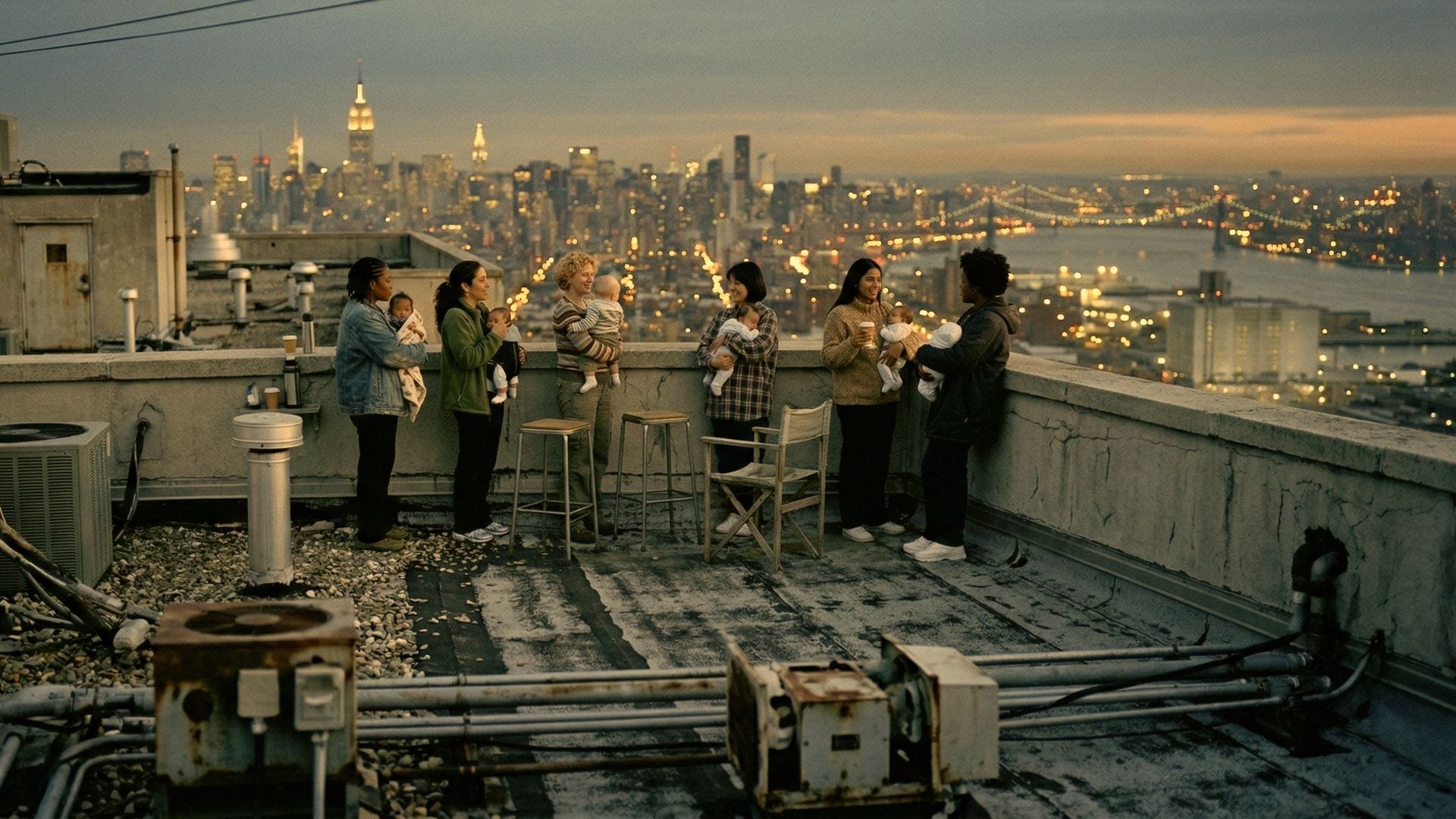
It is June 1, 2004, and I am standing on the roof of a hotel on Lexington Avenue at five in the morning, holding my ten-month-old daughter Miffy, who has decided that New York City is no place for sleep.
She is wide awake. Jet lag has abolished any sense of night for her, and therefore for us. Nicola and I have been taking turns, and this one is mine. I decided to carry her up to the hotel roof while the city was still dark, to watch Manhattan do what Manhattan does before the rest of the world catches up.
Looking back on all the excitement of that trip to New York twenty-two years ago, the thing I remember most clearly is the company.
We were not the only ones up on the rooftop. Other parents from different floors and different countries had reached the same conclusion by the same exhausted logic. By the second morning, we were exchanging the kind of exhausted nods that silently communicated our shared reality: these little shits are keeping us all awake. By the third morning, the nods turned into shared war stories. By the end of the week, we were saving spots at the railing, sharing coffee, and swapping the particular brand of dark humour that only people running on zero sleep fully understand. From memory, I was the only man on the balcony. I don’t remember the names of the mums I hung with, yet I still remember their stories twenty years later.
My Nokia 1100 was useless in New York. Our Australian plan didn’t work in the US, so for 7 days, no one could reach us. No calls, no messages. Nothing found its way through from the other side of the world. We were alone in the modern sense of the word. Unreachable.
Standing on that roof in the early June darkness, I felt a quality of presence I didn’t have a name for yet, because I hadn’t experienced its absence.
We were there for Nicola’s 30th birthday. New York in early summer felt like the right answer to the “what shall we do for your 30th” question. We had a ten-month-old bubba who treated sleep as a philosophical position, and no one on earth could get hold of us.
Looking back, it was the perfect holiday.
We caught the news on the hotel TV in between feeds and nappy changes, absorbing information the way you do when you have a baby: in bits and without much context. And David Bowie kept showing up.
That week, Bowie was everywhere in New York. He had just played two shows nearby: Jones Beach Theatre on June 4 and PNC Bank Arts Centre in New Jersey on June 5. These were the final North American dates of his longest tour, and the city still felt charged with his energy. I loved Bowie the way most people did, completely and for reasons I couldn’t really explain.
There were only three weeks left in Bowie’s Reality Tour before it would end on a stage in Germany, where he would collapse backstage after playing through a heart attack and never perform a headline show again.
On the day before we left, Miffy made her most significant contribution to the city.
We were in a cab somewhere in Midtown when she issued a warning just a fraction too late. What followed was the kind of incident that permanently resets the mood of any enclosed space, especially an NYC cab. The driver pulled over, turned, surveyed us with the calm of someone who’d seen Manhattan’s absolute worst, and said simply, “Out, please, out, out now, oouuuut.”
He didn’t charge us. He just sped off, leaving us standing on the sidewalk in absolute shock.
A New York bystander paused, assessed the scene, and, channelling a sports commentator, loudly announced, “Oh my god, that woman has thrown up all over her baby.”
Just to clarify, it was absolutely the other way around. But on a Manhattan curb, doused in baby sick, no one’s sticking around for your version of events. We pulled ourselves together, flagged another cab with the swagger of the utterly defeated, and retreated to the hotel.
The following morning, Nicola’s birthday, we checked out and went to JFK to catch our flight to London.
At the check-in desk, Miffy delivered an encore performance.
The scale of it was far more impressive than the previous day. The desk, the computer, the woman behind the counter, all of it. There was a pause in our check-in line that felt entirely cinematic.
Then the woman looked at Miffy, then at us, and did something I have never forgotten. She called a doctor, brought out cold towels and peppermint tea, and personally walked us to the first-class lounge to take care of her. She told us to rest and promised we would be the last family called to board. We sat in deep chairs with Miffy draped in a cold towel, pale and small and entirely unbothered by the chaos she had caused. We drank coffee and took a breath.
True to her word, the announcement was made personally over the loudspeaker. Could the Rennie family please make their way to the gate?
We gathered our things and walked down the gangway toward the plane, tired, grateful, and ready to see our family in London.
Boarding the flight, it was just another small group of three and us. I noticed them, but it was the voice I heard first. A British accent, warm and unhurried, directed down at Miffy as Nicola nursed her on her hip.
“Oh, darling. She’s not well, is she?”
Nicola looked up. “No, she’s had a terrible couple of days, actually. She threw up all over the check-in desk.”
“Oh, the poor thing. What’s her name?”
“Miffy.”
“Hello, Miffy. She is so gorgeous.”
I was deep in thought about the long flight ahead with a sick baby. Nicola and her new buddy chatted next to me. Half-listening, I noticed the man stroking Miff’s face. I saw his hand with the rings first. He had a cool voice and treated Miffy with such gentle kindness. That made me look up properly for the first time to say g’day and join in.
What came out of my mouth was not cool. It was far from composed, and a million miles from the measured response of a man who had spent a week absorbing the cultural richness of one of the world’s great cities. It was simply this:
“Fuck. David Bowie! Fuck. Bowie? Jeezus, Bowie!”
He looked at me, then looked at Nicola with considerably more warmth. He looked back at me, shook his head with a slightly disapproving nod, stroked Miffy’s head once more, and quietly said, “Get better, little darling.” He looked at Nicola, said, “Safe travels love” and turned left onto the flight. We turned right to the cattle class. Nicola, cool as fuck, hung with Bowie like old uni mates. Me, on the other hand… well, not so great!
Yep, Miff and David Bowie are connected for life; she has been touched by my version of god, patted by one of the world’s greatest creative artists. And I, in a single moment of unregulated fuckwittedness, ruined it in one second.
Three weeks later, David Bowie walked offstage at a German festival, collapsed, and was flown to emergency surgery for a blocked artery. He performed through a heart attack twice that night. He never headlined a tour again. The man who stroked my daughter’s face at JFK was, unknowingly, in the final weeks of his major performance life. He was heading to Europe to finish his last big performance, and in the midst, stopped to greet a sick baby in a corridor. He was an absolute legend.
I have thought about that gangway a lot over the years. Not just about Bowie, though I think of him too, but about what made that moment possible. That morning, the physical world was all we had. No feed to check. No notification pulled my attention away. The phone in my pocket was a useless plastic rectangle. As a result, I was present (obviously not as present as Nicola). When David Bowie appeared, I felt the full force of his presence, even the part where I ruined the moment by swearing at him.
That is what presence gives us.
In December 2025, I was on a flight from Los Angeles to New York. Staring at my phone, doing nothing in particular, just the low-grade scroll that passes for rest on long flights. The woman next to me gave me a nudge and tilted her head toward the aisle.
I looked up. Alicia Keys walked past.
Here is the thing about that moment. New York Empire State of Mind is the song that made me believe I could one day work in that city. I used to dream about it from a distance, to actually build something there. I heard that song, and something shifted. Years later, I went, found clients and found work. That city became part of my life because a song told me it could.
And there I was, flying into New York with the woman who wrote it, and I was staring at a screen.
Thankfully, there was no dumbfuckery this time. Just a casual nod, to which she responded with a completely justified frown. Although in hindsight, nodding at a stranger on a plane is its own category of strange, so perhaps an ounce of dumb.
I sometimes wonder how many moments like that happen around us. How many extraordinary things occur just three feet away while we stare at glass rectangles? How many Bowies stroke our children’s faces while we manage inboxes? How often does the city try to hand us something, only for us to be too absorbed to notice?
I wonder how we ended up here, craving a rebirth of the nineties. I recently read a string of online reviews for the Love Story series about JFK Jr., and the commentary was overwhelmingly nostalgic for a city with no phones, baggy jeans, and cigarettes. The nineties were genuinely fun. I needed to explore the inventions, choices, and small changes that took us from the rooftop, where strangers became friends in the early morning where connection was human (not a screen), and presence felt normal, to the flight, where someone has to nudge you because you are lost in your own devices (and I do not mean that as a metaphor).
It started with a small blue-and-silver device and a man in Tokyo who was afraid of what he had built.
The First Bubble
It is the summer of 1979, and fifty journalists are sitting on a bus in Tokyo, holding something they have never seen before and cannot quite explain.
Sony’s PR team has driven them to Yoyogi Park, a wide sweep of green near the company’s headquarters. Each journalist has been handed a small, blue-and-silver device, roughly the size of a paperback novel, with a pair of foam-padded headphones trailing from it. The thing has no speaker. It cannot record. It cannot do the one thing that every portable audio device in human history had been designed to do up to that point.
The journalists turn it over in their hands. Some try it as Sony staff members demonstrate around them, skateboarding through the park, riding tandem bicycles, and grinning in a way that feels slightly rehearsed. The scene is, by most accounts, baffling.
The press conference got almost no positive coverage. In the first month, the Walkman only sold 3,000 units, though Sony had expected 5,000. The marketing team went into a state of controlled panic. Akio Morita, Sony’s chairman, was worried about something specific. He tested the device himself, walking through Tokyo with it, and feared that a product built for private listening would come across as rude or antisocial. He cared enough to add a second headphone jack and a small orange button that turned on a microphone, so two people could listen to and talk to each other at the exact same time. He didn’t want his company to be known for making something that kept people apart.
The second headphone jack was quietly removed in later models.
Nobody asked for it back. Nobody noticed it was gone. Morita hadn’t realised that, for most Walkman users, being alone was the main appeal. In eighteen months, Sony sold two million units. The journalists who couldn’t explain the device that day missed what it really was: the first gadget ever made to let you step out of the shared world while physically still standing in it.
Michael Bull, a sociologist at the University of Sussex, spent years interviewing Walkman users to understand what they were actually doing when they put on headphones. What he found was more complicated than liberation. Bull argued that personal stereos let users build private soundscapes, reframe their daily lives, and quietly deny the messy, uncontrollable contingency of the world around them. One of his subjects, asked to describe the feeling, offered three words.
“I just disappear.”
In 2025, disappearing is something we pay for. We book the retreat, roll out the mat, drive to the mountain, and do anything we can to get a few hours away from the noise. We have built an entire wellness industry around the desperate need to be unreachable for a little while.
But in 1979, the device was the escape. The headphones were the retreat. Disappearing felt like freedom because, for the first time, you could choose your own world over the one you were standing in.
The question is what happens when you can’t find your way back.
We Are All Jack Burton
There is a scene in the 1986 John Carpenter film Big Trouble in Little China. I’ll be honest with you: this is not a film for everyone. My wife, an academic with obviously more considerable taste than my own, absolutely refuses to engage with my obsession with it. She groups it with the broader category of films I love, quietly filed under “Ben’s problem”: Stripes, Top Gun, Gremlins, Caddyshack, The Blues Brothers. She is not wrong about any of them. I am not sorry.
Kurt Russell plays Jack Burton, a long-haul trucker who rolls into San Francisco’s Chinatown and finds himself in the middle of a centuries-old supernatural battle between ancient sorcerers, warrior gangs, and forces entirely beyond his comprehension. Throughout the film, Jack narrates his own experience on his CB radio with absolute confidence. He believes he is the hero of his own story. The one steering events. The one in charge.
He isn’t. Jack is, in fact, the comic sidekick. Carpenter and Russell explicitly stated in the DVD commentary that this is a film about a man who thinks he’s the action hero when he’s really just along for the ride. At one point, surrounded by things that make no sense, Jack looks at the camera and delivers a line with complete sincerity.
“I’m a reasonable guy, but I’ve just experienced some very unreasonable things.”
We are all Jack Burton now.
We tell our own stories with confidence. We think we’re in control. We check our phones, scroll through feeds, manage our inboxes, and keep up with messages. It feels like we’re present and connected. But real life is happening on the edges while we stare at our screens. We are reasonable humans, but we are experiencing some very unreasonable things.
The drift is silent. That is what makes it so hard to see.
Before the BlackBerry and before the iPhone, there was a room.
If you were online in the late nineties, you know exactly which room in your house you called the computer room, the spare room, or the study. Whatever your family called it, the ritual was the same. You walked in, sat down, and listened to the modem negotiate its way onto the network, that screech and crackle and rising digital hum, the sound of two machines deciding whether to trust each other over a dial-up connection. And then you were in.
When you were done, you clicked Disconnect. You stood up, walked out, and closed the door. The internet stayed in the room. The kitchen was the kitchen. The bedroom was the bedroom.
You were, in a very real sense, unreachable, and it did not feel like a problem. It just felt like any given Tuesday.
It didn’t happen all at once. Over time, the internet stopped being a place you visited and started being something that followed you home.
Brain Drain
The first sign of what was coming was the BlackBerry. It did not take long for users to become addicted to BlackBerry’s nearly instantaneous email delivery. The nickname CrackBerry was meant to be funny. It wasn’t actually a joke.
The legal system began to notice what was happening before most people did. In Chicago, a police sergeant named Jeffrey Allen sued the city for violations of the Fair Labour Standards Act. Allen claimed that the City did not pay him overtime for the time he spent checking his email while off-duty. More than fifty current and former members of the Chicago Police Department’s Bureau of Organised Crime claimed they were expected to monitor and respond to calls and messages on their department-issued BlackBerrys while off-duty and without pay. They had crossed the line so many times, in both directions, that they could no longer tell where work ended and the rest of their lives began.
Neither could anyone else.
Nobody told the officers to check messages at midnight, any more than anyone explicitly told me to reply to emails at 10 PM. The expectation just appeared, like fog, slowly and without warning, until one day you look up and can’t see the road.
Around 2010, I found myself in a room with a senior BlackBerry executive. We were talking strategy, discussing how they had built such ferocious loyalty in the enterprise market, and how entire organisations had become structurally dependent on their infrastructure. He described their approach with a phrase I have never forgotten.
We call it “Easy in, impossible out.”
He said it like it was just good business. Make it easy to start using, and then make leaving feel as hard as surgery without painkillers. Once a company built BlackBerry into its email, security, and always-on culture, leaving was almost unthinkable.
I nodded, paused, and thought: Wait, that is a clinical description of addiction.
What makes that conversation extraordinary in retrospect is not that BlackBerry did it. It is that every platform that came after them took that philosophy and applied it to the whole of human life. Easy in, impossible out stopped being a model for enterprise software. It became the architecture of the internet itself.
Then came the iPhone, and the architecture went global.
In June 2007, Steve Jobs walked on stage and described it as three things in one. The crowd cheered. Steve Jobs made the internet the default state of being. There is a reason he never let his own kids have an iPhone.
Sociologist Linda Stone, who worked at Apple and Microsoft and witnessed this change, gave it a name. She called it continuous partial attention. It is not multitasking. Multitasking means doing two things at once well, which I think is fucking rad. I wish I could do two things at once well, but as my kids will attest, I absolutely cannot. Not even once.
Continuous partial attention is a constant state of being almost here and almost somewhere else. You are present enough to get by, but too distracted to ever fully arrive. (This was also known as my default state on any given Friday night in the nineties: continuous partial immaturity).
In 2017, a researcher at the University of Texas named Adrian Ward gave 800 people cognitive tests, varying only one thing: where their phone was. Some had it in another room. Some had it in their pocket. Some had it face down on the desk in front of them, switched off, silent, and untouched. The people whose phones were in another room significantly outperformed everyone else. Ward had a name for what was happening to the rest of the group: brain drain. The subconscious process of stopping yourself from thinking about your phone actively uses up the cognitive resources you need for everything else.
The phone doesn’t even need to be in your hand. It just needs to be in the room.
The science behind this is an uncomfortable read. Every time your phone buzzes, it triggers the release of cortisol, the main stress hormone. Notifications keep your brain on high alert by repeatedly triggering the stress response. Your phone eases stress for a fleeting moment, but raises it consistently over time. You feel anxious, so you check your phone. That makes you feel better for a bit. But checking trains your brain to expect more notifications, raising your baseline stress and making you reach for your phone again.
There is a name for what happened to us, and it did not happen all at once.
It started the way most significant changes do: with something genuinely useful. The Walkman gave you music on the train. The BlackBerry kept you up to date with your email. The iPhone put the world in your pocket. Each one arrived as a tool, something you picked up and put down, something that served you. At the moment you first held it, it was exactly that.
The drift began in the space between those moments. It did not happen in a single decision, but through the slow accumulation of small ones. You checked the email at dinner once because it was urgent. Then, because it might be urgent. Then, because you were just in the habit. The phone moved from the desk to the pocket to the bedside table so gradually that there was never a morning when you woke up and thought: Today I am going to let this machine become part of me. It just got closer and closer until the distance between you and it effectively disappeared.
Call it Digital Drift. It is the slow, unnoticed migration from a person who uses a device to a person who feels incomplete without one. It is not addiction in the clinical sense, though the architecture is deliberately designed to rhyme with it. It is something quieter and more universal. It is what happens when a tool becomes an atmosphere. It happens when the thing you picked up to serve you becomes the thing you reach for before you are fully awake, and when being without it for an hour feels not like freedom, but like a phantom limb.
The reason it matters is not the phone itself. It is what the phone displayed. Every moment of continuous partial attention is a moment taken directly from something else. The dinner table. The school play. The rooftop at five in the morning above a city is doing something extraordinary, if only you are willing to look at it.
Easy in, impossible out. Fuck BlackBerry.
Easy in, impossible out is a biological feedback loop designed by people who knew exactly what they were building.
The Empty Walls
Pip was six or seven when she had her first major breakdown in the house. She was usually incredibly chill, though as she grew up, it turns out that wasn’t always the case. She was a force of nature in a small body, competitive, curious, extremely sure of her opinions, and prone to eruptions of feeling that arrived without warning and took time to decode. On one particular afternoon, something broke loose in her that none of us could immediately explain.
It started with an irritability as she walked through the house, then tears, then a full retreat to her bedroom, back pressed hard against the door so we couldn’t get in. Nicola and I stood in the hallway deploying our most sophisticated parenting techniques, which at that moment amounted to talking gently at a closed door and exchanging looks of total helplessness. I was, and remain to this day, entirely useless at negotiating with anyone I love, especially my own babies. They just win every time. The manosphere would eat me alive in thirty seconds if I ever opened the portal.
After close to an hour, the door opened.
Pip was calm as she looked at me with completely clear eyes and said, very simply: “There are no photos of me on the walls. Only Miff and Kai. This family hates me; my love for you all has gone!”
As I said, she won. I had no answer.
She was right.
Together, shocked and a little defensive, we walked slowly through the house and looked at the walls the way she had looked at them. Framed photographs on the sideboard. Prints from beach holidays. The kids at various ages, Miffy grinning with a missing tooth, Kai as a toddler at the water’s edge. Miff and Kai were everywhere. We found exactly one tiny photo of Pip as a brand new baby in Miffy’s arms, and that was it.
Sure, there were photos of Pip, too. Of course, there were. Thousands of them. Tens of thousands. But none of them was on the walls.
Because Pip was a digital baby.
Miffy and Kai were born when photos were printed, held, argued over, picked, framed, and hung on the wall. By the time Pip was born, we were taking pictures with BlackBerrys and iPhones. We had more photos of Pip than the other two combined. We captured every moment but showed almost none, because the photos stayed on our phones, and phones don’t hang on walls.
Pip was not grieving a shortage of love. She was grieving a shortage of evidence. She had been thoroughly documented and completely invisible. She had been captured at infinite resolution and left out of the story on the wall.
That’s what the drift does to what matters most. It doesn’t erase these things. It just moves them somewhere harder to find. (And yes, we have plenty of photos of Pip on the wall now. She made absolutely sure of that.)
The antidote to this drift is not complicated, which is almost the most annoying thing about it.
You already know what it feels like. You have felt it, probably more recently than you think, during a long meal where the conversation ran past midnight, or on a walk where you left the phone at home by accident and noticed twenty minutes in that you were actually looking at things. The state the brain drain study measured, the cognitive capacity that returns when the phone leaves the room, is not a specialised, high-performance condition. It is just what your mind feels like when it is fully yours.
Digital Drift reverses the exact same way it began. Not in a single dramatic gesture, but in small, deliberate ones. An hour in the morning before the phone comes off the bedside table. A meal that stays zipped in your bag. A walk where you go the long way and refuse to document it. The rooftop, in whatever form your life offers it, is chosen on purpose and fiercely protected.
You are not trying to build a time machine back to 2004. You are just trying to remember that the person you were on that rooftop, present, unhurried, and available to whatever the city was about to hand you, is still in there.
There is a moment near the end of Big Trouble in Little China that I keep coming back to. Jack Burton has just survived an ancient supernatural war beneath the streets of San Francisco. He has watched sorcerers battle, buildings collapse, and demons dissolve into dust. He climbs into his truck, pulls out into the night, and picks up his CB radio.
“This is Jack Burton in the Pork Chop Express,” he says, “and I’m talking to whoever’s out there.”
Whoever’s out there. That’s the thing about a CB radio. It was a form of connection that was also, frequently, a form of talking into nothing. You broadcast on a channel, hoping someone was listening. Sometimes they were. Often they weren’t. It was communication as an act of faith, transmission without guarantee of receipt. A voice going out into the dark and not always coming back.
Jack drives off alone, narrating himself back into the story, completely unaware that he barely participated in the events he just lived through. His lights dissolve into the dark as the CB crackles, and nobody answers.
It was played for laughs, but I think of it more as a metaphor for what was to come.
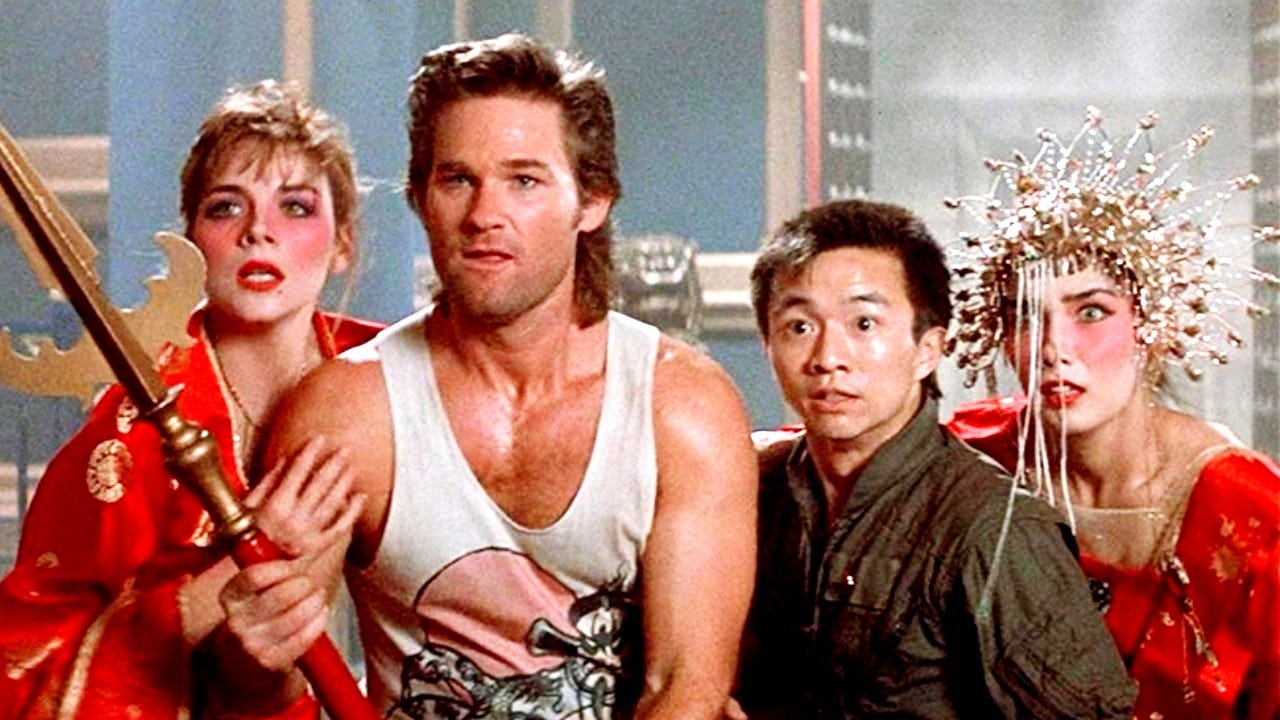
We all know that feeling. We have all sat at a table full of people and been somewhere else entirely. We have all watched something happen in real time and thought about how we would describe it later. We have all been at a concert, a sunset, a birth, and felt the reflex to reach for the device before we felt the moment itself. We have all been Jack Burton, narrating our own lives into a CB radio, talking to whoever’s out there, hoping someone is listening, completely missing the battle happening right in front of us.
The phone is a tool. But tools reshape the hands that hold them, and we have been holding this one long enough that the shape has changed.
The computer room had a door. We could walk through it in both directions. The door is gone now, and most of us have forgotten that walking out was ever an option.
It still is.
The rooftop was twenty-two years ago. The friends I made up there, whose names I never wrote down, whose stories I still remember, they existed because there was nothing else to do at five in the morning above Lexington Avenue except be there. The city below us was doing what cities do. We were present for it completely, unreachable and unhurried, and the week handed us things we could not have planned for.
A kind woman at a check-in desk. David Bowie on the gangway.
You cannot engineer moments like that. You can only be available for them.
The rooftop is still up there. The city is still doing what it does at five in the morning. The only thing that has changed is that we now have to choose to leave the phone downstairs before we go up.
Think of it like the moment we collectively realised the Marlboro man was cool as fuck but probably killing us, so we quietly put down the cigarettes and picked up the peppermint tea (or a can of Coke). That was never going to be an easy trade. But we made it (well, most of us) because humanity has always found its way back to what actually matters. That is what we do. We drift, and then we find our way back.
Adam Duritz from Counting Crows, who I consider a genuine god of lyrics (right behind Bowie), wrote something that has stayed with me for thirty years.
I am covered in this skin, no one gets to come in. Pull me out from inside. I am folded and unfolded and unfolding. I am ready. I am fine.
There is a version of us that stands at the railing and lets the city arrive before reaching for something else. That saves a spot for a stranger and remembers their story twenty years later. That looks up from the screen in time to see what the world is offering.
That version of humanity is not lost. It’s found.
And maybe it is ok to be unreachable for a little while.
A note on this chapter
and my moral tension in writing this:
I write in three ways. I tell my stories into a dictaphone on long drives. Never on walks. The car is where the stories come out. I transcribe these into a Google Doc and draft from there. I then edit without AI. I use Grammarly to tighten the writing and resist its AI suggestions, because every time I accept them, the prose starts to sound like someone else. I am slowly learning to trust my own voice more than the tool, trying to improve it.
I do use AI, and I choose to use Claude rather than ChatGPT, which I deleted. I use it for ideas, structure, flow, and as a sounding board, but I do not fully trust it. It generalises in ways that water down exactly what I am trying to say, and I struggle to see real value in it beyond efficiency, which is precisely what this book argues against. There is a genuine moral tension in writing about the cost of convenience while using convenient tools to write it. I am conscious of that.
For research, particularly the psychology and neuroscience that runs through this book, I lean on Google NotebookLM to help me navigate academic papers I would not otherwise know how to read. I am not an academic, so I take care with how I present ideas that I am still learning to understand, and I have come to see that as part of the process. Writing about things you do not fully understand is the best way for me to begin understanding them.
Chapter 5 will be written without any of this. Just me, the dictaphone, and Google Docs.
For now, the struggle is real.
Has writing this chapter made me stop staring at my phone? Not entirely. But something has shifted. I leave my phone in the car at sports. I go into café meetings without it. I have changed the screen to muted greens and greys to make it less appealing, and I have turned off every notification for the first time in my life. My watch now tells me about important meetings. When it pings for 3 pm meetings, I check it and prepare. I don’t find Instagram waiting for me on the watch, so whether that is the same problem on a different device, I genuinely do not know. But there is less temptation, and that feels like a start.
I hope this chapter landed for you (hmmm, landed, a word I never used prior to AI, so again, an example of how my writing, how I think about writing, and the words I use shift because of the technology). Great fucking word though!
Thank you for being here.
Ben