

Serialisation Chapter 1: The Body Knew First
Welcome to Chapter One, the second installment of my book serialisation for my second book, Be Kind Rewind.

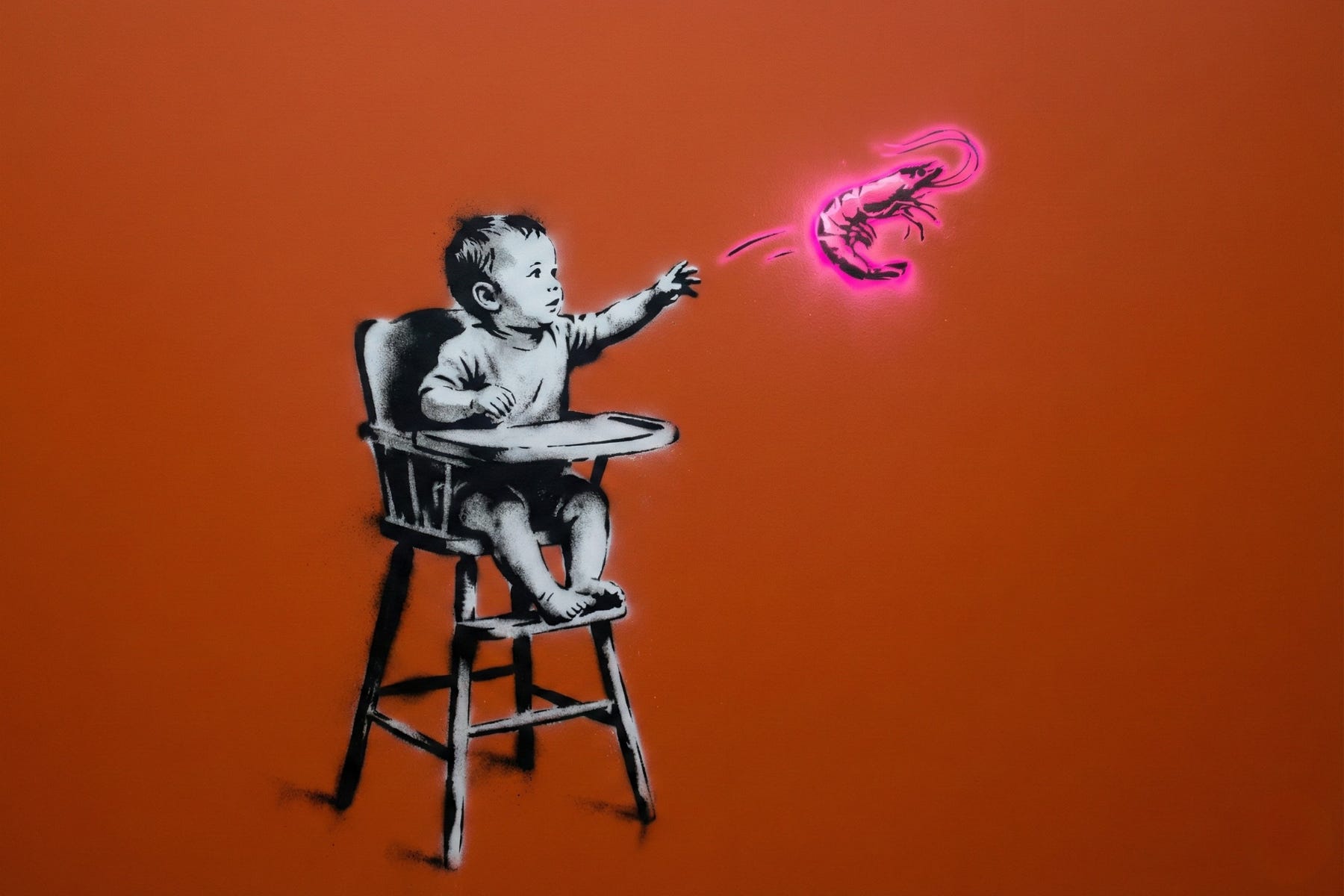
If you are reading this, it means you are a paid supporter of this project & my Substack, and I want to say a massive thank you. Your support is what makes the public writing process work. As a reminder, jump into the comments when you finish reading. If a story sparks a memory for you, share it or challenge the ideas here. The comments will help shape the final manuscript, and you will get a Co-Author credit in the back of the book. Let's get into Chapter 1.
- Ben
Serialisation One (Start here if you missed the intro): Be Kind Rewind Introduction
Chapter One: The Body Knew First
To understand what we traded, we have to go back further than the video store. Further than the Walkman. Further than the modem in the spare room. The roots of human agency do not begin with technology. They begin in the body, long before we had any idea what agency even was.
It begins in a high chair.
I want you to think of a specific moment. It might be a memory of your own child, a younger sibling, or perhaps just a scene you witnessed in a local café.
Picture a six-month-old child strapped in. The parents are trying to feed them, but the child is interested in something else. They are holding a spoon. They look at it. They feel the cold metal. And then, with great deliberation, they open their fingers and let it drop.
Clang.
The spoon hits the floor. The parent sighs, picks it up, wipes it off, and gives it back. The child grabs it, pauses, and drops it again.
Clang.
To a tired parent, this looks like mischief or just a mess. But to the child, it is the scientific method in action. They are testing gravity, gathering data, and learning how the physical world actually works.
A hands-on experiment like that requires a properly tactile laboratory. And for my family, that laboratory usually smelled like sizzling Mongolian lamb and deep-fried ice cream.
I am talking about the unapologetically old-school Australian-Chinese restaurant. The places with heavy red carpets that have absorbed decades of spilled soy sauce. The squeaky wooden lazy Susans. The sweet and sour pork that glows with a radioactive, neon hue. I love these places because they are deeply, undeniably physical (and yummy). They are loud and sticky, and irrespective of how the food tastes, they demand my presence. I just love a good Chinese meal in a classic Australian establishment.
Which is exactly how we ended up in a busy, noisy dining room in Kiama, a few hours south of Sydney, with our daughter Miffy.
Miffy is twenty-two now, but back then, she was an eleven-month-old force of nature often covered in Vegemite, always competitive (yes, even as an eleven-month-old baby), and forever inquisitive. On this particular night, she was strapped into a wooden high chair, faced with a mound of special fried rice.
But she was not interested in eating. She had discovered a game.
She reached out and pinched a single, bright green pea between her thumb and forefinger. She looked at it intensely, feeling the squishy texture. She locked eyes with a diner sitting at the neighbouring table. And then, with the surprising accuracy of a major league pitcher, she launched it across the room.
The pea sailed through the heavy restaurant air. Smack. It hit the stranger in the neck. He swatted it away like a fly as Nicola and I lifted our heads to the ceiling, admiring the decor, whispering a quiet “what the actual fuck just happened” under our breath.
But Miff didn’t stop there. The special fried rice was an ammunition depot. Next came the squares of fake, Devon-like ham. Then came the prawns. She would pick up a prawn, gauge its weight, and fire it into the crowd.
She watched them fly. She watched them land. Then she leaned forward to observe the reaction of the people she had just assaulted with the fried rice buffet.
To my wife Nicola and me, this was a diplomatic incident waiting to happen. We were genuinely freaking out. We did the only thing we could think of. We took the bowl away.
We waited for her to calm down. Once she seemed ready to behave, we cautiously slid the fried rice back onto her high chair tray. Instantly, she picked up another prawn and fired it at a completely different table.
This standoff lasted forty minutes. It was a relentless cycle of confiscation, parental negotiation, and incoming artillery fire. It only ended when she finally realised she was actually hungry and decided to eat her remaining ammunition.
To be honest, I was torn between proud dad (what an arm!), supportive husband (I don’t know what’s gotten into her!), and disciplined father (now this is your final warning, Miff!).
But looking at Miffy’s face, I realised she was not trying to be naughty. She was learning science.
She was asking fundamental questions about the universe. How much force do I need to reach that table (or do Prawns fly)? Does the pea make a sound when it hits the back of a stranger’s head? Does a prawn fly differently than a square of spam? Does the feeling of letting go always result in the object disappearing from my hand? Why does my Dad lose his mind at the sight of a pea flying?
When a prawn hit the stranger, Miffy was not just making a mess; she was mapping reality. She was learning that distance is real, that objects have mass, and that she was a separate entity from the world around her.
This is the beginning of agency. It is the first moment a human being realises a profound truth. I do X, and Y happens. We tend to think of learning as something that happens entirely in our heads. We imagine the brain as a computer that processes information, and the body as a mere vehicle that carries the computer around. But that is not how we were built.
We do not think and then move. We move to think.
The Hand Built the Brain
If you want to understand how humans actually learn, you have to look at a map of the brain. But not a standard medical diagram. You need to look at the Cortical Homunculus.
This is a visual representation of the human body, but it is distorted. It is drawn based on how much brainpower is dedicated to processing sensation and movement for each body part. If you physically built a human being based on this neurological map, they would look terrifying.
They would have a tiny torso and thin, spindly legs. But they would have a gigantic mouth and enormous, oversized hands.
The hands are massive because the connection between the hand and the brain is the superhighway of human intelligence. For millions of years, our survival depended on our ability to manipulate the physical world. We had to grasp, throw, dig, and weave. We had to feel the difference between a ripe fruit and a rotten one. We had to feel the tension in a bowstring before we let the arrow fly.
The hand did not just execute the brain’s commands. The hand taught the brain how to understand the world.
If you don’t believe me, think about the old push-in cigarette lighters that used to come standard in every family car. It feels like half the kids in Australia share a generational trauma from those things. You know the ones, they left a perfect, permanent spiral burn on the skin, usually right on the pad of a thumb.
Your parents warned you a hundred times not to touch it. They explained the danger perfectly. But the temptation of pulling out that glowing orange metal was too great. Your brain heard the warning, but your thumb still reached out, thinking, Hmmm, I wonder exactly how hot this is? A parent’s lecture couldn’t encode the lesson, but the blister certainly did. Like I said: the hand taught the brain how to understand the world.
Psychologists call this embodied cognition.
Below the paywall: Why Mr Miyagi was a better neuroscientist than modern tech developers (and the tech bros), what a giant Jenga tower in a Nebraska diner taught me about consequences, and the biological reason you feel so exhausted after staring at a screen all day and what to actually do about it.
