

Be Kind, Rewind Serialisation: The Introduction
Serialisation Part 1: On Utah, video stores, and the Invisible Trade of modern life.

A Note Before We Begin:
The response to last week’s announcement to write this book in the open was overwhelming. Thank you. It confirmed that I am not the only one who feels the world has become faster but thinner, and that we all need to be a little braver.
So, let’s get to work.
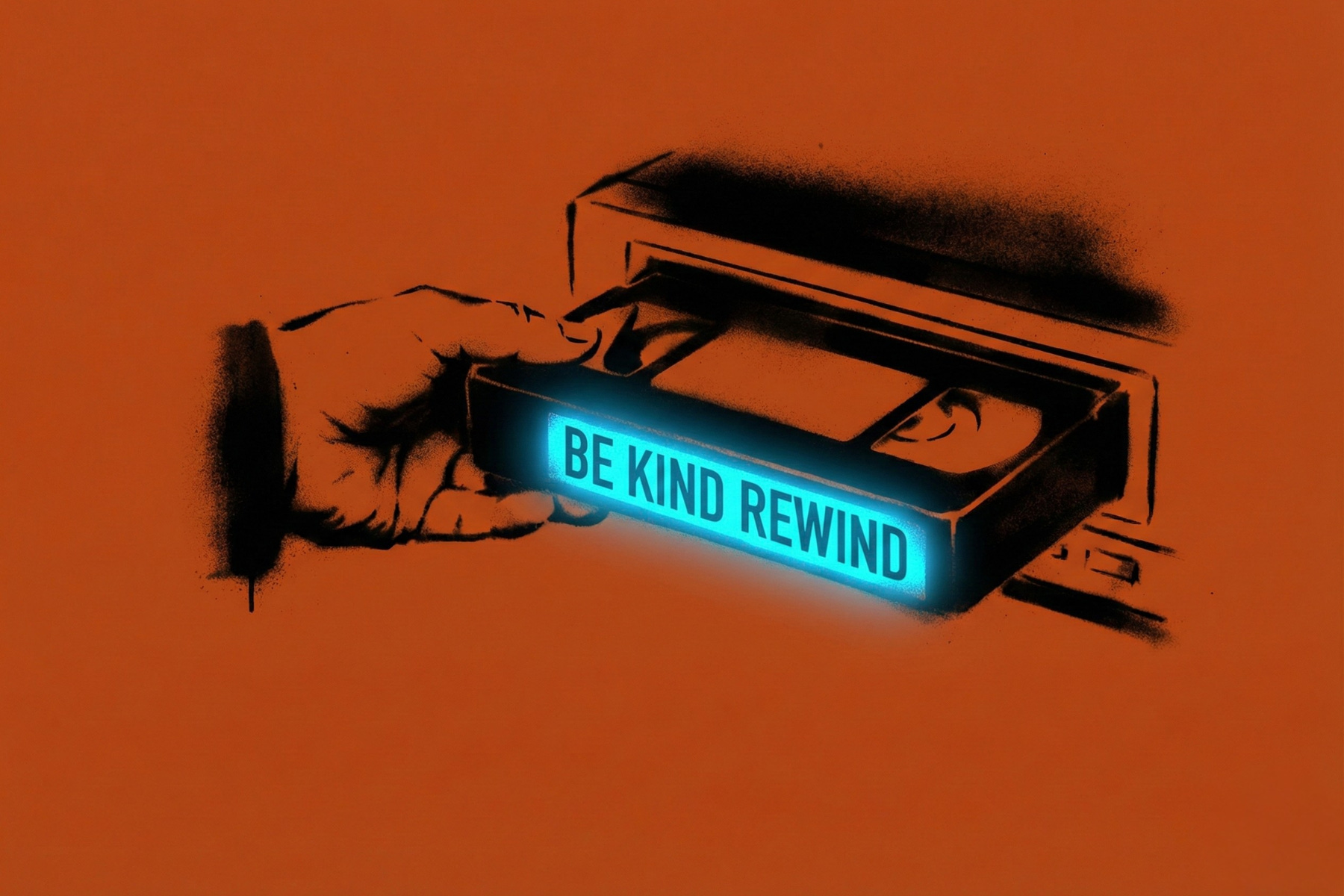
Below is the Introduction to Be Kind, Rewind.
This is not Chapter 1 (that comes next month), this is the book’s introduction after the index, to set the scene.
This piece of writing attempts to name the feeling we have all been carrying, the sense that, in our rush to make everything seamless, we accidentally smoothed away the things that made life stick.
I call it “The Invisible Trade.”
As you read this, think about your own “friction” moments. The things you hated doing then, but strangely miss now. The waiting, boredom and the silence.
Read it slowly, and if you see yourself in the Utah car or the video store aisle, let me know in the comments.
We start here. Remember, you are writing this with me, let’s get it!


Introduction: The Invisible Trade
Book: Be Kind Rewind
Author: Ben Rennie
WordCount: 2,265
Version: 2
Read Time: 9 Minutes
Serialisation: Email 1 The Introduction
It is January 2023. I am in the car with the family, driving through Utah, cutting through the long, white silence between Salt Lake City and the Colorado border. The mountains are endless, the reception is patchy, and the world outside feels vast and untouchable.
Inside the car, it is warm. We are doing what families do to survive a ten-hour drive on the interstate: we are having a sing-along.
A song spills out of the speakers. It starts with a folk strum, building into something anthemic. It sounds familiar; it feels like something we have owned for years, so we join in. The rhythm catches us. My daughter, Pip, is in the back seat, belting it out, hitting the high notes with her eyes closed. We all know the chorus. We know exactly where the drop is coming.
The song fades out, and the cabin settles back into the hum of the tyres. I realise that while I know the melody, and I know the hook, I cannot picture the face of the man who just sang to us.
“Who is that?” I ask Pip. “Who’s singing?”
She looks up, pauses, and gives a small shrug. “I’m not actually sure,” she says. “Let me check.”
She leans forward, tapping the iPhone screen. “It’s a guy called Noah Kahan, Dad, I love him.”
We look at each other. The name means nothing to us (at the time). We shrug again. I decide right then that I love it. We add him to the favourites. We drive on, and Noah Kahan stays in the rotation all the way to Denver.
In one sense, this is a magic trick.
The system worked exactly as it was designed to. Somewhere in a server farm, a recommendation engine analysed the spectral data of our listening history. It noticed our heavy rotation of Zach Bryan. It triangulated that with millions of other users who fit our demographic profile, dads who like Americana, and teenagers who like indie-folk, and it calculated a high-probability match.
It didn’t just guess; it predicted.
It served up the song at the exact moment our attention might have drifted. It was seamless and efficient. It was a zero-friction transaction where we consumed the art without ever needing to introduce ourselves to the artist.
But looking back, that shrug haunts me.
We knew the song, but we didn’t know the story. We had the content, but we lacked the context. The algorithm had solved the problem of discovery, but in doing so, it had removed the necessity of curiosity.
It wasn’t always like this.
I remember a time when knowing a band required more than just hearing them. It required a kind of courtship.
I remember growing up and discovering Michael Hutchence and INXS. My best friend, Jason Stone, once told me, with absolute authority, that INXS was for “older teenagers” and that we were not ready for them yet. I remember looking at the cover and wondering what exactly we weren’t ready for.
I spent hours poring over album covers, decoding the symbols. I unfolded the paper sleeves to discover the lyrics, reading them like they were scripture. I thought about the photographer, the designer, the person who had painstakingly chosen the font.
I knew the artists because I held their work. I knew their words from the printed sheet before I had ever heard them sung.
Before the internet, buying a record or a tape was a pilgrimage. You had to travel to the store. You had to make a choice with the limited money you had earned. You had to judge the album by its cover or by a friend's word.
The friction was the value.
In the car in Utah, the music was effortless and flowed like water. But because there was no cost to acquire it, there was no investment in keeping it. We had traded the friction of discovery for the convenience of the stream. We had the song, but we had lost the story.
The same shift happened in how we watched stories.
I want you to picture a Friday night in the mid-nineties. You are walking into a Video Ezy or a Blockbuster. It is late, perhaps 7:30 PM, and the air smells like a mix of cheap industrial carpet and sweet popcorn. The fluorescent lights hum overhead. You are there for one reason: to choose the two or three films that will define your weekend.
The aisles are lined with shelves, and on those shelves are physical boxes. You walk past the cardboard cutouts of action stars and romantic leads, standing like silent sentinels in the centre of the store.
You pick up a case. It is plastic and slightly padded. You flip it over to read the synopsis on the back. You check the rating. You look at the grainy stills.
If the movie is popular, the shelf might be empty, save for a little plastic tag behind the box that says “Out on Rent.”
Remember the specific pang of disappointment that tag created? It was a physical feeling. You had to pivot. You had to negotiate. You stood in the aisle with your friends or your parents and debated the merits of an action movie versus a comedy. You asked the person behind the counter for a recommendation.
When you finally made a choice, you took the empty display case to the counter, and they swapped it for a heavy cassette in a hard plastic shell. You paid your money. You committed.
This process was full of friction. It took time. It required travel. It involved the risk of a bad choice. But that friction served a function we did not understand until it was gone.
I remember this vividly with a movie called The Crying Game.
It was 1992. The entire world seemed to be whispering about this film. The marketing campaign was brilliant and infuriating. It was built entirely around a secret. The posters literally asked the audience not to spoil the ending.
Naturally, the playground rumour mill was in overdrive.
My best friend, Jason Stone, was the unofficial Associated Press of our high school. One day, he leaned in and whispered the secret code. “She is a he.”
That was it, that was the rumour. “She is a he.”
At sixteen, I didn’t know what that meant. My understanding of gender (at the time) was binary and mostly theoretical. The world hadn’t given me language for anything more nuanced than that. Was it a disguise? Was it a joke?
I had to know. But in 1992, curiosity had a price tag.
I rode my bike to the video store. I paid my five dollars, which was a significant percentage of my net worth. I rented the tape. I rode home. I waited for my parents to go out, and I put the cassette in the machine.
Now, here is the thing about The Crying Game that the internet generation will never experience. It is not a ten-second TikTok reveal.
The first hour of that movie is a slow, character-driven British drama about the IRA, kidnapping, and guilt. It requires patience. In the age of streaming, I would have been bored after fifteen minutes. I would have paused it, opened Wikipedia, read the “Plot” section to find the twist, watched the ten-second clip on YouTube, and moved on.
I would have turned the art into information.
But I had paid my five dollars. I had skin in the game. So I sat there. I watched the protagonist, Fergus, fall in love with Dil. And because the movie was good and I was trapped in the room with it, I started to fall for Dil, too. She was charming, enigmatic, and beautiful.
Then came the scene.
I won’t tell you exactly what happens. If you haven’t seen it, you deserve the same experience I had. But the secret was revealed. The rumour was true.
My fifteen-year-old brain did a somersault. It was a genuine “WTF” moment.
But here is the miracle that friction provided. I didn't turn it off, and nor was I offended; I was curious.
Because I had spent an hour getting to know this person, I couldn’t dismiss her as a punchline or merely a curiosity. I was already invested. I had to sit there and reconcile what I was seeing with who I had come to know.
It was a quiet, internal collision. I sat there in the dark and realised that my understanding of attraction, and of gender itself, was more complicated than I’d been taught. That “woman” was a category bigger and more complex than the narrow definition I’d carried into that room.
It didn’t break my compass. It just widened the map.
If I had Googled the twist, I would have seen the image, but I would have missed the humanity. I would have judged the visual without knowing the person.
The friction of the format and the fact that I had to sit through the slow parts forced me to feel empathy. It forced me to understand the context before I judged the content.
We traded that friction for efficiency. We can now find out “the twist” in three seconds. We can categorise people instantly. But we have lost the long, slow arc of getting to know them first.
We traded the surprise for the spoiler. And in doing so, we made it much harder to be surprised by our own capacity for empathy.
This is what friction does. It creates Skin in the Game.
The “Be Kind, Rewind” sticker on the tape was not just an instruction; it was a reminder that this object belonged to a community. You were a steward of the story for a night, and then you passed it on.
Today, the friction is gone. We have infinite libraries in our pockets and living rooms. We can start a movie, watch for three minutes, get bored, and switch to another. We can scroll through titles for forty-five minutes and watch nothing at all.
This is the trade.
We traded the friction of the video store for the convenience of the stream. In doing so, we traded the depth of our attention for the breadth of our access.
When the cost of entry is zero, the value of the experience often falls to zero. When we can have everything instantly, we stop cherishing anything specifically. Life feels faster, but it also feels thinner. We consume more content than any generation in history, yet we often feel less satisfied by it.
This book is about that trade. It is not just about music or movies. It is about how we learn, connect, pay attention, and build confidence.
We did not lose these human capacities. We simply traded away the environments that sustained them. We accepted the promise of easier lives without reading the terms and conditions.
The good news is that these trades are reversible. Once we see them clearly, once we understand what we gave up to get here, we can begin to make different choices. We can choose to put the friction back in. We can choose to be deliberate.
We can choose to rewind.
We tend to believe that we lost our creativity because we grew up. We think we lost our ability to focus because we became busy. We assume our confidence faded because the world became more complex. We treat these losses as inevitable symptoms of aging or the natural wear and tear of adult life.
That is not true.
We do not grow out of creativity. We are designed out of it.
We do not lose our capacity for attention. We place ourselves in environments that systematically fracture it.
The human brain has not changed significantly in the last twenty years. Our biology is the same. Our fundamental needs are the same. What has changed is the container we live in. We have surrounded ourselves with tools that offer speed and convenience, but we failed to ask what they would ask in return.
There is an old German legend that speaks to this. It is the story of the Faustian Bargain.
In the legend, a scholar named Faust makes a deal with a demon. He is offered unlimited knowledge and worldly pleasures. He is promised that he can transcend the limits of human experience. In exchange, he must give up his soul. He accepts the deal because the immediate gain is tangible and the cost feels abstract and distant. He gets exactly what he asked for, but he loses the part of himself that allowed him to enjoy it. (We will talk more about the Faustian Bargain throughout this book.
We have made a similar bargain in the twenty-first century.
We accepted the smartphone, the algorithm, and the infinite feed. We accepted them because they offered us something miraculous. They gave us the ability to know anything, to reach anyone, and to be entertained anywhere. They solved the problem of boredom. They solved the problem of isolation. They solved the problem of waiting.
But technology is not additive. It is ecological.
When you introduce a new technology into a culture, you do not get the old culture plus the new technology. You get a completely new culture. The technology gives, but it also takes.
We thought we were getting tools that would serve us. We did not realise that in an economy based on attention, we were not the users of the tools. We were the fuel. We were the currency.
For every moment of connection we gained, we traded a moment of solitude. For every ounce of efficiency we gained, we traded the slow, messy process of discovery. For every seamless recommendation we accepted, we traded the agency of choosing for ourselves.
This is the core human cost I explore in this book. It is the loss of agency.
Agency is not just the ability to do what you want. Agency is the lived sense that you are the author of your own experience. It is the confidence that you can shape your environment rather than just reacting to it. It is the difference between driving the car and being a passenger in an autonomous vehicle.
In an accelerated system, we are increasingly becoming passengers. The algorithm chooses the song. The feed chooses the news. The platform chooses the pace. We are moving faster than ever, but we are steering less.
I started writing this book because I began to notice a specific kind of exhaustion in the people around me and in myself.
It wasn’t just that we were busy. It was that we were brittle.
I saw creative directors who had lost the confidence to start a project without first opening Pinterest. I saw friends who could not sit through a dinner without checking a notification. I saw parents, myself included, handing over screens to quiet our children, only to wonder later what muscle we were allowing to atrophy.
I realised we were trying to run ancient biology on modern software, and the system was crashing. We were trying to stay human in an environment designed to make us mechanical.
I wrote this book to find out if there was another way. I wanted to know if it was possible to live in the digital world without losing our analog soul.
The question is not how we destroy these systems. We cannot uninvent the internet, nor should we want to. The question is how we stay human within them.
How do we maintain our ability to think deeply when the world demands we skim? How do we build creative confidence when the tools do the work for us? How do we reclaim our attention when the smartest minds in the world are paid to steal it?
We do it by noticing the trade.
We do it by recognising that friction, effort, and slowness are not inefficiencies to be eliminated. They are the essential conditions for human growth.
When we walked into that video store in 1995, the “Be Kind, Rewind” sticker was a request for courtesy. Today, it is a philosophy for living.
To rewind is not to retreat. We are not trying to build a time machine. We cannot go back to 1995, nor should we want to. The medicine has improved. The access to knowledge is miraculous. We do not want to live in the past. We want to carry the wisdom of the past into the future.
When you press the rewind button, the world outside does not stop. Time continues to move forward. The tape spins backward, but the clock ticks on.
The act of rewinding is simply a choice to pause the rush. It is a decision to go back and retrieve something we left behind. We go back to recover the context, the patience, and the friction that made the story meaningful in the first place.
We rewind so that we can be ready to play the movie again, properly this time.
It is a deliberate choice to take the slower, harder way because that is where the meaning lives. We stay human in accelerated systems by refusing to be passive. We stay human by remembering that we still have the power to choose.
We stay kind. And we rewind.
END INTRO
NEXT CHAPTER: PART ONE, CHAPTER ONE: What the Body Knew All Along
The Margins Are Open
This is where the ink dries, and the conversation begins.
This Introduction is free for everyone because I believe we all need to understand the ‘Invisible Trade.’
However, Chapter 1 (What the Body Knew All Along) will be available shortly and will be for Paid Subscribers only.
Furthermore, only Paid Subscribers can comment below to share their stories and earn a ‘Co-Author’ credit in the final book. If you want to be in the margins with me, upgrade today.
As I mentioned in the launch, I am not writing this book in a vacuum. I am writing it with you.
