

Faceless Creativity
Do Not Disturb!

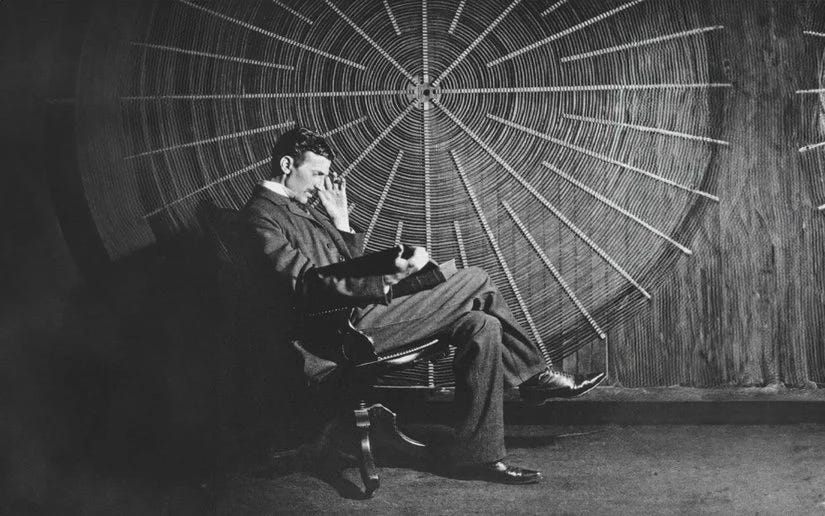
On the morning of January 8th, 1943, a maid named Alice Monaghan stood in a corridor on the 33rd floor of the Hotel New Yorker, looking at a Do Not Disturb sign that had been hanging on the same door for two days. The hotel had rules about such signs, and the rules said to leave the guests alone. But two days is a long time, and something about the silence behind the door of room 3327 troubled her enough to let herself in.
The man she found had been dead for perhaps a day. He was 86 years old, thin from a diet that had dwindled in his final years to milk and crackers, and he owed the hotel money. The staff knew him as a quiet old man who used to feed the pigeons in Bryant Park. Within hours of the maid’s discovery, agents of the United States government arrived and seized all the papers in his room.
Outside the window, New York went about its morning. The lights in the offices, the trains under the streets, the radio playing in the hotel lobby downstairs, the current moving through the walls of the very room he died in. All of it, the power and the currents, ran on his ideas. The man was Nikola Tesla, and he had designed the electric heartbeat of the modern world, and the modern world had, in return, given him a small room, a debt, and two days of silence as he lay dead behind a closed “Do Not Disturb” sign on the door.
Eighty years later, the richest man on earth runs a car company that borrows Tesla’s name. He didn’t found the company; he bought his way in and later secured, by legal settlement, the right to call himself the founder. Even the appropriation has appropriation on top of it. I turn this over in my head a lot, and I talk about this to pretty much anyone listening (or not listening, ahem, sorry Nicola), which is the value of what designers make always lands somewhere. Sometimes good, sometimes bad, but good design is never neutral. Design compounds and concentrates to build towers, fortunes, and empires. And it almost never lands on the person who made the thing (or designed it).
I want to be careful with the word designer, because I mean it broadly, yet I do mean it on purpose. I am talking about anyone who gives form to an idea that will end up in a stranger’s life. The engineer is sketching a coil in a Manhattan lab. The architect is drawing a shell on a kitchen table in Denmark. The student in my studio at UNSW is developing a wayfinding system for a hospital she will never be a patient at. Design, in this sense, is the act of making decisions on behalf of people who are not in the room. Most of us believe the work is for the client, the stakeholders, the steering committee, and the people across the table who approve the invoices and attend the workshops. But the client is a channel, and the real audience is the faceless millions who live beyond the engagement, the people who will hold the thing, ride the thing, get lost or found inside the thing, decades after everyone in the room has moved on. Design is for the people we will never meet.
No life makes this argument more completely, or at greater personal cost, than the life of Jørn Utzon.
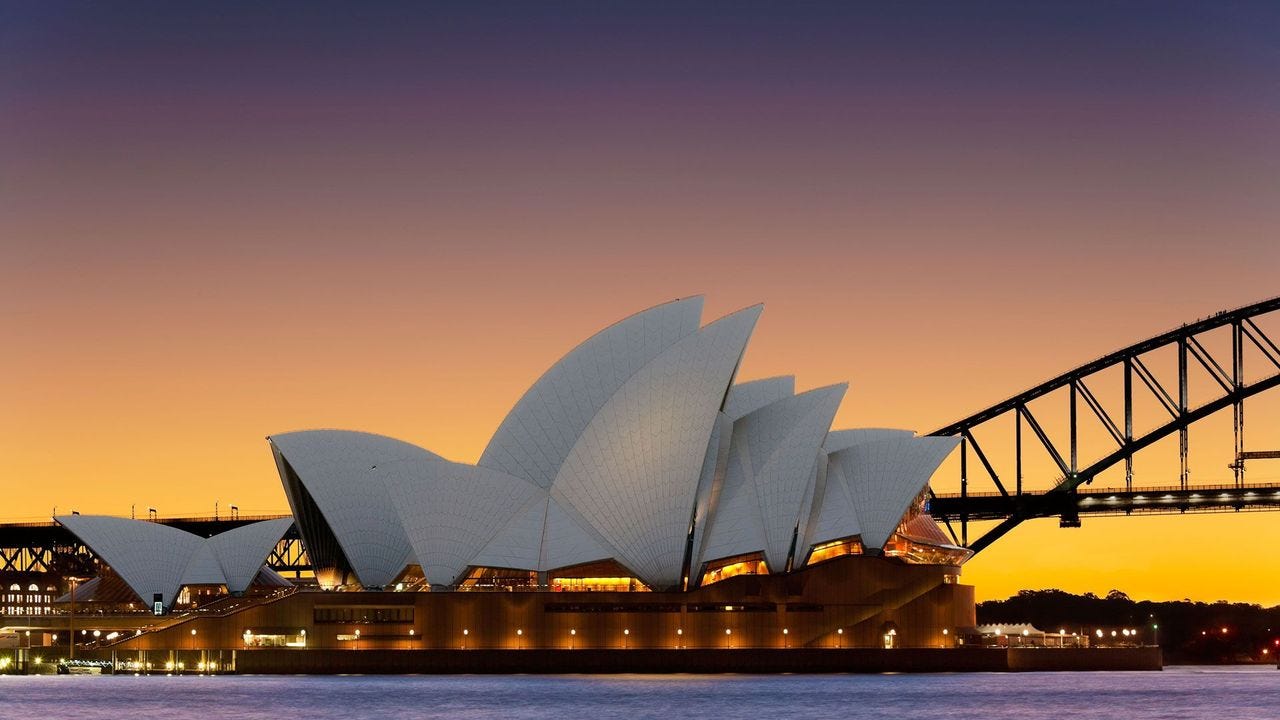
In 1956, Utzon was 38 years old, working from his home in Hellebæk, north of Copenhagen, when he entered an international competition to design an opera house for a point of land jutting into Sydney Harbour. He had never been to Australia. He studied nautical charts of the harbour and photographs of the site, and he understood that a building surrounded by water on three sides would be seen from every angle, from ferries and headlands and aircraft windows, and so it didnt need to have a back, it just need to be seen. Every side had to be a face. The story goes that his entry had already been set aside when Eero Saarinen, arriving late to the judging in January 1957, went back through the rejected pile, pulled out Utzon’s drawings, and told the other judges they were looking at genius. The scheme was barely more than a gesture. A podium like a Mayan platform, and above it a set of white shells (or Sails) that nobody, including Utzon, yet knew how to build.
The prize for winning was £5,000 ($199,444 AUD in 2026), and I want you to hold on to that number because we will come back to it.
Utzon moved his family across the world and gave the next chunk of his life to solving the problem of his own imagination: building the Sydney Opera House. For years, the Opera House design refused to stand up. The engineers ran the calculations again and again, and the geometry kept failing, until Utzon found the answer in the simplest place possible: every shell (or Sail) could be cut from the surface of a single sphere, the way you’d peel segments from an orange. It remains one of the great structural insights of the twentieth century, and it meant the impossible building could actually be built, rib by prefabricated rib.
Then, as they always seem to, the politics arrived, the way politics does, wearing the costume of fiscal responsibility. The project’s cost had been announced in 1957 at seven million dollars ($83,482,600 in 2026 money), a number invented for an election, attached to a design that existed only as drawings. By the mid-sixties, the real figure was climbing towards what would finally be a hundred and two million ($1.22 billion in 2026 money), and a new state government came to power in 1965 having campaigned on the overrun. The new Minister for Works, Davis Hughes, a country accountant with no feeling for the building and considerable feeling for the architect’s weakened position, began withholding Utzon’s fees. There was no dramatic sacking. There didn’t need to be. Payment by payment, month by month, the man was starved off his own project, until he owed money he could not pay and was drawing on loans to keep his office open. In February 1966, believing the government would have to back down, Utzon resigned. The government accepted his resignation the same day.
He left Australia a few weeks later. He told no one, and he passed through a side door at the airport to avoid the press, a man exiting his own life’s work through the service entrance. He was 47 years old, and he never set foot in Australia again.
The building was finished by others, its interiors compromised, its acoustics argued about for the next fifty years. When Queen Elizabeth opened it in October 1973, Utzon was not invited, and his name was not mentioned in the speeches on the steps that day. Sit with the shape of that. The most recognisable building on earth opened without its architect’s name ever mentioned. He had designed it for people he would never meet, and by the end, he had become one of them, a stranger to his own building, knowing it only as the rest of the world knew it, through photographs.
The vindication took forty years, which is to say it took almost exactly one career, the career he gave. The Pritzker Prize, architecture’s Nobel, came in 2003, and the citation made a point of the wound, noting that he had created one of the century’s great iconic buildings and had been prevented from completing it. In 2004, the Opera House opened the Utzon Room, the only interior in the building designed by the man himself, and he designed it from Denmark, in his eighties, working from drawings, photographs, and memory, shaping with total precision a room he knew he would never stand in. In 2007, the Sydney Opera House was inscribed on the World Heritage list while its architect was still alive, something that has essentially never happened; buildings usually have to outlive their makers by generations to earn it. He died the following year, at 90. His son Jan collected the honours on his behalf, standing in rooms his father made and never entered.
Remember the £5,000.
In 2023, for the building’s fiftieth birthday, Deloitte tried to put a number on the value of Utzon’s Sails. The precinct generates 1.2 billion dollars for the economy every year and supports around 8,000 jobs. Nearly eleven million people visit annually, more than the entire population of Utzon’s Denmark, making the pilgrimage every twelve months to a building sketched at a kitchen table in Hellebæk. And when Deloitte tried to measure the building’s total social value to Australia, the number they arrived at was 11.4 billion dollars. The men who starved Utzon off the project to save money are footnotes now, their names remembered mainly for what they did to him. The overrun they weaponised, from seven million to a hundred and two million, was paid off by 1975 through a state lottery, and has since returned itself to the country hundreds of times over. It may be the best investment in Australian history, and the state of New South Wales spent the 1960s treating its designer as the problem.
This is the pattern Tesla’s hotel room was pointing at, and once you have seen it, you cannot unsee it. The wealth of our age rests on the work of people who leaned in and gave form to something. The car company, the rocket, the streaming platform in your pocket, each one sat first in the hands and mind of a designer, and the fortunes built on that work have mostly pooled elsewhere, in the hands of people whose contribution was capital and timing. Capital has a way of treating the maker as a phase the money passes through, useful during creation, inconvenient afterwards, the way Hughes treated Utzon and the way the century treated Tesla. If money is for anything, it is for access, for freedom, for the chance to live a full life and create opportunity, and when it stops being for those things, it has only one remaining use: power. And power has always understood something makers are slow to learn: that it needs them far more than they know.
A few voices have tried to tell designers this to their faces. In 1971, an Austrian-born designer named Victor Papanek opened his book Design for the Real World declaring industrial design as one of the most harmful professions in existence. His argument was simple: designers were spending their talent on the comfortable slice of humanity that could pay, while most of the world’s actual needs, the needs of the poor, the disabled, the distant, went unserved. The profession responded by casting him out. He was expelled from his professional body and spent years in exile, dismissed. His book has since been translated into more than twenty languages and is arguably the most widely read book about design ever published. His vindication, like Utzon’s, arrived decades late. The profession punished the man who took the unseen audience seriously, and then, a generation later, built its conscience on his name.
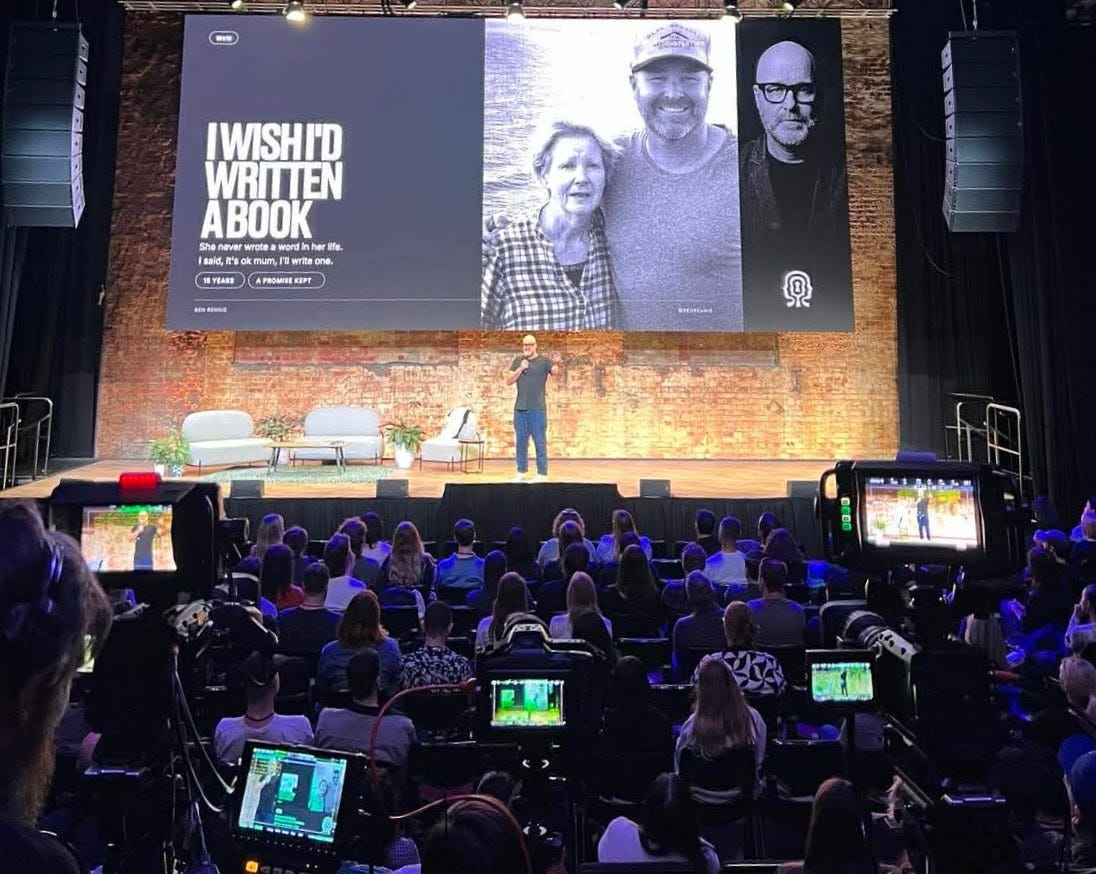
I thought about all of this last week in Brisbane, at the design conference at the Powerhouse. The week was full of quotes and inspiration, the way these weeks are, but underneath the program, there was something else, a charge in the room, a raw energy I haven’t felt at an industry gathering in years. Everyone was circling the same question. AI is coming, and everybody knows it. Here is what I believe about it, as plainly as I can put it down. AI is coming for the mediocre, because right now it is the best version of mediocre ever built, and its mediocre design beats your mediocre design for the oldest reason in commerce: it costs less. When cost is the competitive advantage, nobody wins; that race has one direction, and it is down. But there is a deeper reason the machine cannot do the real work, and it is the whole argument I am trying to make. AI cannot design for people it will never meet, because it has never met anyone. It has no memory of watching a stranger struggle with a door, no grandmother, no injured pigeon. Empathy for the unseen person is precisely what the machine lacks, and precisely what was always the designer’s actual job. The engagement was never the work. The engagement was the doorway to the people beyond it.
And the market, unsentimental as it is, already knows this. When McKinsey studied 300 companies over five years, tracking two million pieces of financial data against a hundred thousand design decisions, the companies in the top quartile for design grew revenue 32 percentage points faster than their industry peers, and returned 56 points more to shareholders. Read those numbers again and notice what they are measuring. They are measuring, in dollars, the distance between organisations that design for the people beyond the room and organisations that design for the room.
This is what I am trying to convince my students of at UNSW, and I am not sure they feel the weight of it yet. Every decision they make in the studio will eventually land in the life of a stranger. The designers of past generations had nothing like the reach my students now hold; a single interface decision made by a 24-year-old can touch more human beings in a week than Utzon’s building has welcomed in fifty years. Even the small work carries it. A thing designed only to make someone smile still reaches into a life you cannot see and changes the temperature of a day, and that is weight, and that is consequence. I want them to graduate knowing that the room they are designing for is always, always bigger than the room they are standing in.
I will finally admit that I am doing the same thing right now. I love to write, until I don’t. In the middle of it, I am free of every concern; the more I write, the more my worries thin out and disappear, and the thoughts are out there and no longer in here. Then the doubt arrives, usually in a pub on a weekend, in the voice of a friend telling me with absolute confidence that writing is dead, that no one reads anymore, that with AI coming, who the fuck would write for a living, and for whom, and where is the money in it, why would a grown man spend his hours on something that pays nothing. He gets drunker and louder as the night goes on, and the last comment I remember was that writing is for egomaniacs.
A sidenote, for the record: I do make money from writing, not enough but far more than I ever dreamed of (which is perhaps my own roundabout way of agreeing with him that there is no money in it, although there is, but again, not my measure of success here). But now, back on track, I like to listen to the question underneath the question. It is asking me to measure the work against the faces in front of me, the doomsayers at the table, and I hope by now I am making it clear that this is the same mistake this entire piece is about. My writing, like the Opera House on the harbour, is for people I cannot see and may never meet, and their absence from the room is not evidence that they don’t exist.
Recently, a reader sent me an infographic she had made of my writing. She and her husband had been sharing the stories over breakfast, reading them aloud to each other in the mornings, and the infographic mapped what had changed in their lives because of the writing, what happened to them, to their relationship, to their perspective. It gave me goosebumps and freaked me out at the same time. We influence, all of us, sometimes one person and sometimes many, whether we believe we do or not.
So what does all of this mean? If the finest architect of the twentieth century can be starved off his own masterpiece, if the man who electrified the world can die in debt behind a Do Not Disturb sign while the fortunes built on his work anoint other men as gods, if we have arrived at a moment when we trust the internet more than we trust our friends, then we are standing at a crossroads. If we are, we need to understand what the crossroads is telling us.
The more I age, the more I see it, the obvious signals that tell us that recognition is a lagging indicator, sometimes lagging by forty years, sometimes by a lifetime, and so it makes recognition a shit compass. It is telling us that value and reward travel separately, and that anyone who waits for the second before creating the first will create nothing. It is telling us that the systems around creative work will protect the systems long before they protect the people doing the work. But beneath it all, the crossroads is telling us one thing above all else: to create the thing you dreamed of creating.
In 1968, a researcher named George Land gave 1,600 five-year-olds a creativity test he had originally designed to help NASA find its most inventive engineers, and 98 per cent of those children scored at the level the test called creative genius. When the same test was given to adults, the figure was 2 per cent, a collapse from ninety-eight to two somewhere between the sandpit and the office, and the world manages it through schooling and deadlines and the slow instruction that success means avoiding mistakes. I want my students, and you, to flip that arithmetic because there’s a strange liberation hiding inside everything I am doing my best to describe here. No one is watching you. No one! And more than that, no one cares what you do next, what you write, what you sing, how you dance, and I mean that with complete seriousness, because the judges nearly left Utzon’s Opera House in the rejected pile and the world let Tesla feed pigeons alone for twenty years. The lack of care is the permission. It is the open door that oligarchs, ministers, and pub critics are too busy to guard; they don’t know how, so go and make.
Because something happens in the act of doing it anyway. Your own moonwalk, your own fight, your own failure, your own broken product on its third redesign, these become evidence for someone you will never meet that a human being tried, and in that evidence they find hope, and in that hope they find the nerve to try themselves. That is the quiet economy, the one that runs beneath the visible economy of fees and fortunes, the one Utzon paid into for forty silent years, and Tesla paid into until the morning the maid opened the door. The machines are rising, and so are we, and as we rise, so do others, the ones beyond the engagement, beyond the pub, beyond the door, who are out there right now, waiting to find the thing you are about to create.
Hey Ben - great article - I was just looking at Vincent Wards visuals for Aliens 3 before he was ran off by accountants and ego maniacs and your article popped up in me feed. I really like your version of design as the act making and how important it is. Can we ever untangle ourselves from the rat cage of capitalism? If we do Im sure some one will have the ratsack ready. Keep up the writing an yes the great unseen, unwashed and silent are reading, watching and listening.
It's the best of your writing that I've read. Go well, Ben.